
October 1, 2026
The Hidden Cost of "Just One More Change"

QLeap
Can we just add one more field?
It is probably one of the most familiar sentences in software development. Sometimes it really is just a field. The change gets made, tested, released, and everyone moves on.
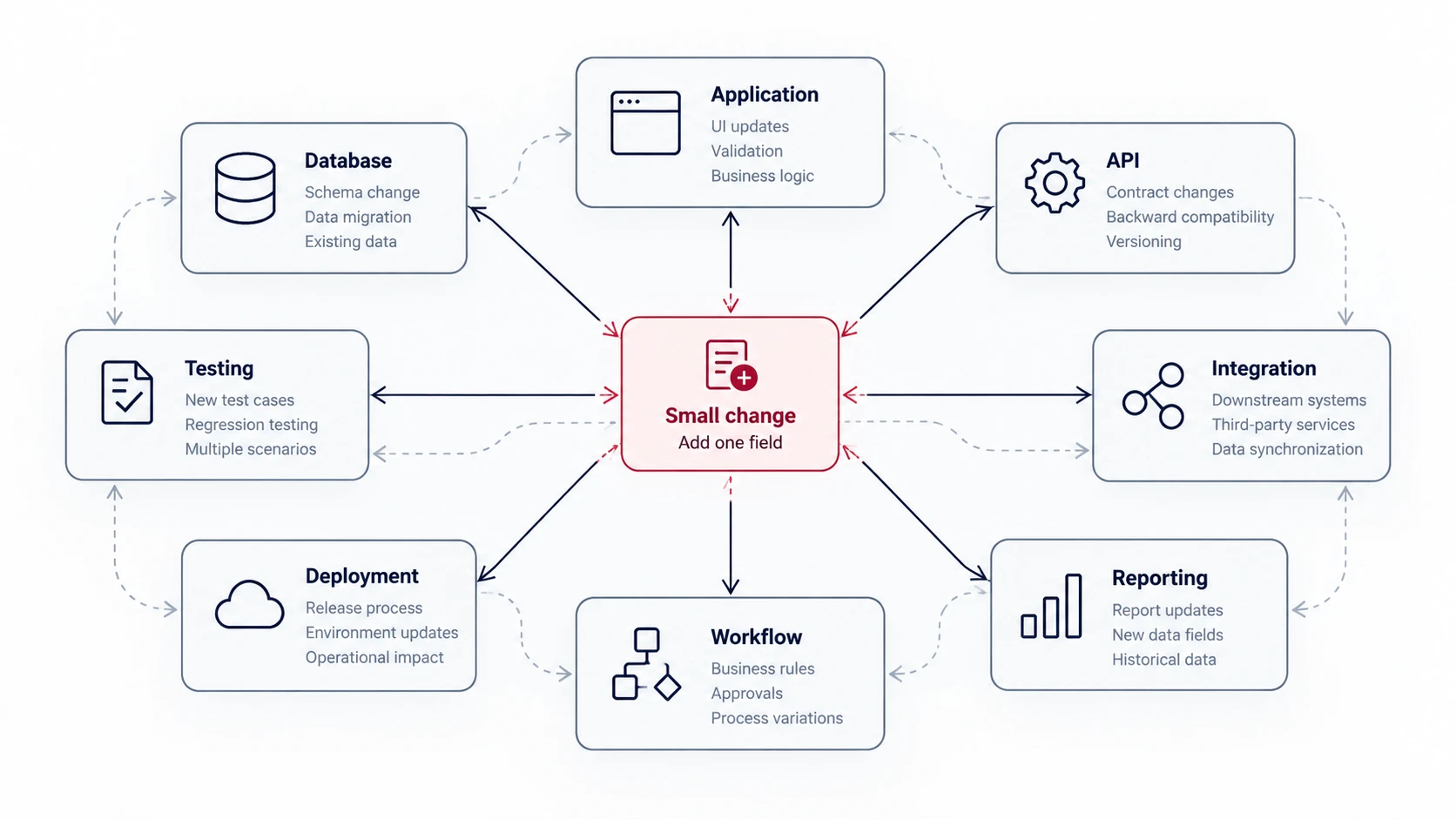
The trouble starts when “one more change” isn't really one change at all. A new field can change a business rule. A business rule can change a workflow. A workflow can affect an API, a database, an integration, a report, or an assumption that another part of the system has quietly been relying on.
None of this is unusual. It is simply how software grows. The interesting part is what happens when these changes keep arriving.
It rarely looks complicated at the beginning
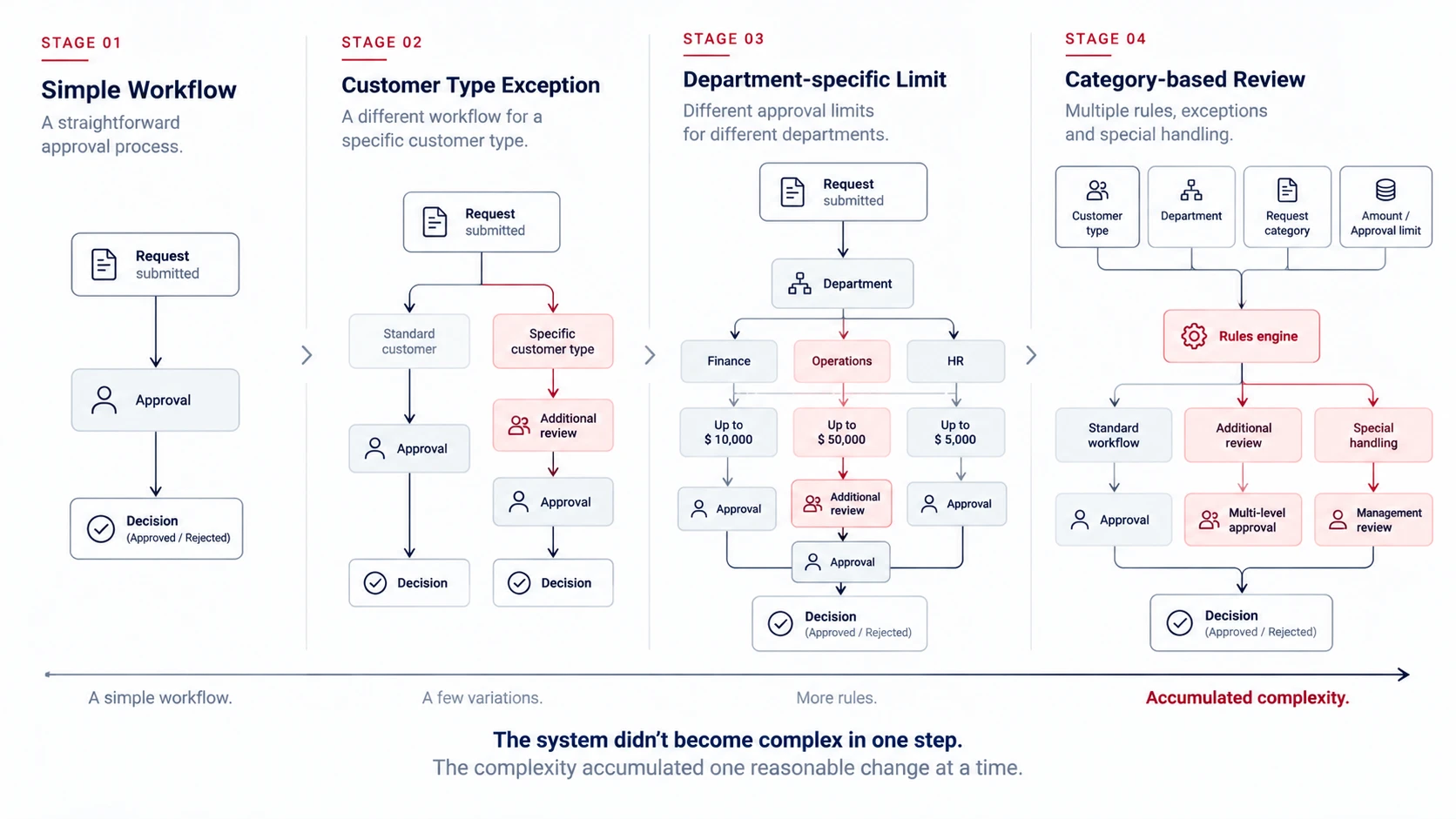
Consider a business application with a straightforward approval process. A request comes in, someone reviews it, it gets approved or rejected, and the result is recorded. Then a customer asks for a slightly different workflow for a particular type of request. The first implementation is probably straightforward. Add an attribute, introduce another path in the workflow, update the relevant screens, and test it.
A few months later, another request arrives. This time, certain requests should skip one approval step. Then another department wants a different approval limit. Then a particular category requires an additional review.
None of these requirements is unreasonable. In fact, each one may make perfect business sense. But the original workflow is no longer just a workflow. It has become a collection of rules about when the normal process applies, when it doesn't, and which exception takes precedence when two conditions overlap. That is where things start getting interesting.
The code isn't the whole cost
When someone asks how much a change will cost, the first instinct is often to estimate the development effort. That's necessary, but it is only one part of the picture. A change to a business rule might require a database change. It might affect an API consumed by another application. It might alter a report or notification. It might require existing data to be migrated or interpreted differently.
And then there is testing. The new scenario needs to work, but all the old scenarios need to continue working too. As variations accumulate, the number of combinations that need to be considered can grow surprisingly quickly. There can also be deployment and operational implications. So the question isn't simply how long it takes to write the code. It is how much of the surrounding system needs to understand the new behavior. That distinction is easy to miss when a requirement is described as a “small change.”
The interesting part is what happens next
The first workaround is rarely the problem. The second usually isn't either. The problem is that reasonable short-term decisions can quietly become the architecture of the system.
A temporary field becomes something that other services depend on. A special condition gets copied into another part of the application. A workaround becomes the only way to support a particular customer. Eventually, someone encounters a piece of logic and asks why it exists.
The answer might be:
Because that was required for one customer two years ago.
That doesn't mean the original decision was wrong. It means the system remembers decisions long after the circumstances that created them have changed. This is one of the less obvious forms of technical debt.
Complexity has a way of compounding
There is an important difference between adding functionality to a system and adding complexity to it. The two aren't always the same thing. A well-designed system can gain new capabilities without making every future change substantially harder. Another system might gain roughly the same capabilities while accumulating dependencies, exceptions, and duplicated rules along the way.
From the outside, both systems may appear to be delivering the same features. The difference becomes visible when the next requirement arrives. A developer working on a system with accumulated complexity needs to spend more time figuring out what might break. Testing becomes broader. Releases become more cautious. New developers need more time to understand the codebase. Eventually, even a modest requirement can require a surprisingly large amount of investigation.
The system hasn't necessarily become unreliable.
The system hasn't necessarily become unreliable. It has become expensive to change.
This is where architectural debt matters
Technical debt is often discussed in terms of code: shortcuts, duplication, workarounds, or outdated components. Architectural debt is broader. It can show up in the way services communicate, where business rules live, how data is owned, how integrations are structured, or how responsibilities are divided across the system.
And unlike a piece of code that can simply be refactored, architectural debt can be deeply connected to other parts of the platform. That is why some changes become progressively harder. The problem isn't always the new requirement. Sometimes the new requirement is simply exposing a limitation that has been building underneath it.
Not every change needs to become an architecture exercise
This is where engineering discussions can become unnecessarily complicated. Not every request deserves a redesign. Businesses need to move quickly. Features sometimes need to be tested before anyone knows whether they will become permanent. There are situations where taking a shortcut is entirely reasonable.
The key is knowing what you're trading off. If a team says, “We'll implement this quickly because we want to validate the idea first,” that's a conscious decision. If the same shortcut is taken repeatedly because nobody has stopped to look at the larger picture, that's something else.
The difference is not whether technical debt exists. It is whether the team knows it exists and has made a deliberate decision to accept it.
A few questions can change the conversation
The next time a requirement sounds like “just one more change,” it can be useful to pause for a few minutes.
- 1What business rule is actually changing?
- 2What existing functionality depends on that rule?
- 3Does the change affect data, integrations, or downstream systems?
- 4Are we adding another exception, or are we discovering a pattern that should be represented more deliberately?
- 5If a similar requirement arrives six months from now, will this design make it easier or harder to support?
These aren't questions intended to slow development down. They're intended to make the real scope of the decision visible.
Sometimes the answer will still be:
It's small. Let's do it.
That's a perfectly good answer. The important thing is that it is an informed one.
Good architecture doesn't eliminate change
A system that never changes is usually not a sign of good architecture. Requirements change. Processes change. Customers ask for different things. Regulations change. New systems need to integrate with old ones.
Good architecture doesn't try to prevent that. It gives change somewhere sensible to go. That might mean separating business rules from presentation logic. It might mean defining clearer service boundaries. It might mean designing for configuration where genuine variation is expected. Sometimes it might simply mean recognizing that a particular part of the system has reached the point where it needs to be redesigned.
There isn't one architectural answer. There is, however, a useful habit: look beyond the immediate change. Because the hidden cost of “just one more change” isn't usually the change itself. It is what the change leaves behind. Another dependency. Another exception. Another assumption. Another piece of history that the next developer has to understand.
One change rarely causes trouble on its own. But enough individually reasonable changes, made without periodically reconsidering the structure underneath them, can make a system progressively harder to evolve. And that is ultimately what good engineering should try to avoid.
Not change.
Unnecessary complexity.
A practical takeaway
Before approving the next “small” change, it is worth asking one additional question:
Are we adding functionality, or are we adding another exception to the way the system works?
The distinction can be easy to miss. It can also determine whether the next change takes two days or two weeks.