
September 30, 2026
What Makes a Technology Architecture Ready for Scale?

QLeap
A scalable technology architecture is one that can accommodate increasing workload, users, data, and business complexity without requiring fundamental redesign every time the system grows. A system can work perfectly well today and still be completely unprepared for tomorrow.
Maybe it handles the current number of users without a problem. The database responds quickly. Deployments are manageable. Infrastructure costs are predictable. Then the business grows.
More users arrive. Transaction volumes increase. New integrations are added. More teams start working on the product. Suddenly, things that were never a problem before begin showing up everywhere: slow APIs, database bottlenecks, fragile deployments, unexpected failures.
This is usually when the conversation turns to scaling infrastructure. More servers. Bigger databases. Caching. Load balancers. Containers. Sometimes those are exactly the right answers. But scalability starts much earlier than that.
A technology architecture is ready for scale when the system can grow without every increase in demand turning into a redesign, a performance problem, or an operational headache. And that involves considerably more than infrastructure.
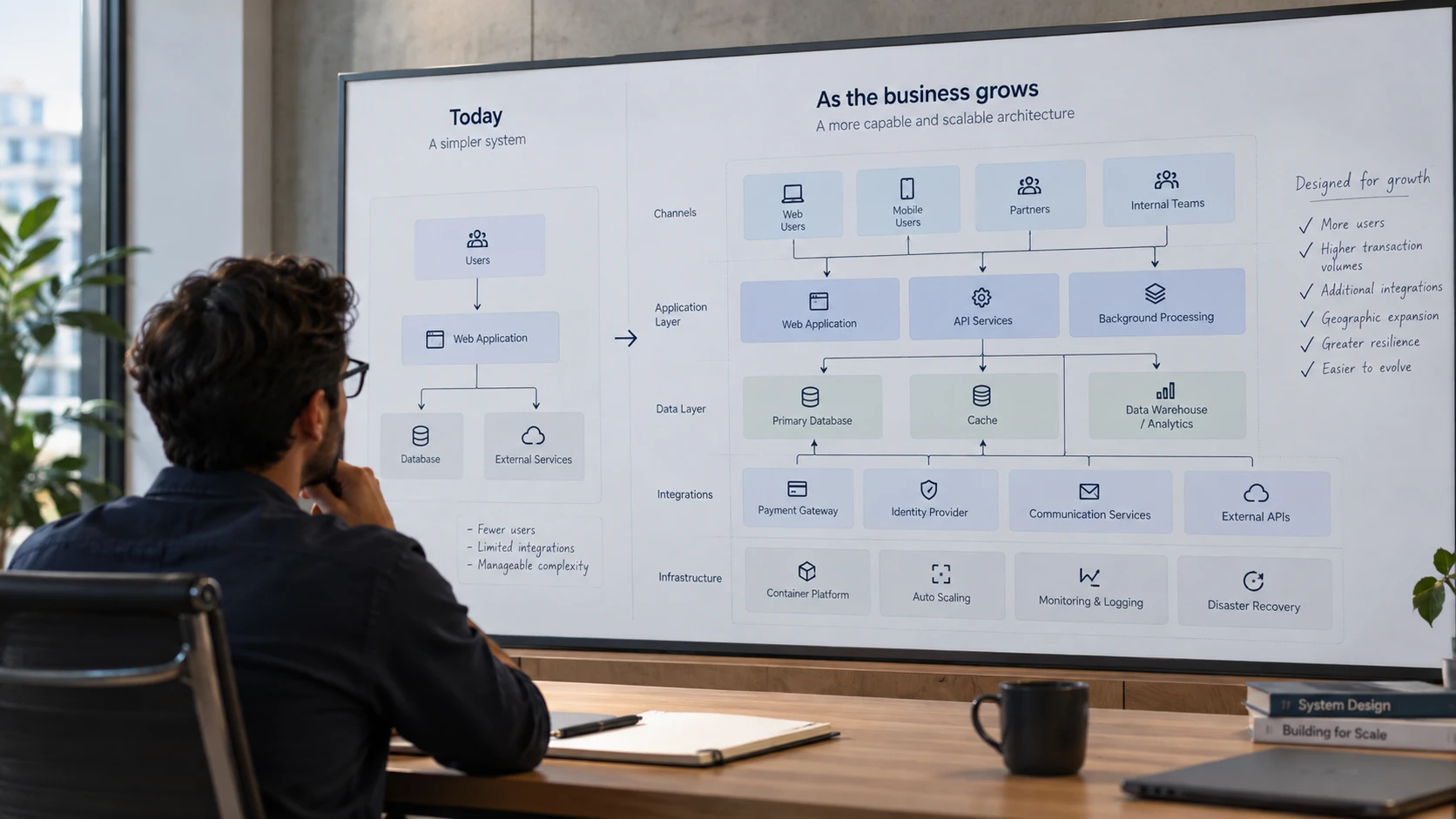
Start with the business, not the technology
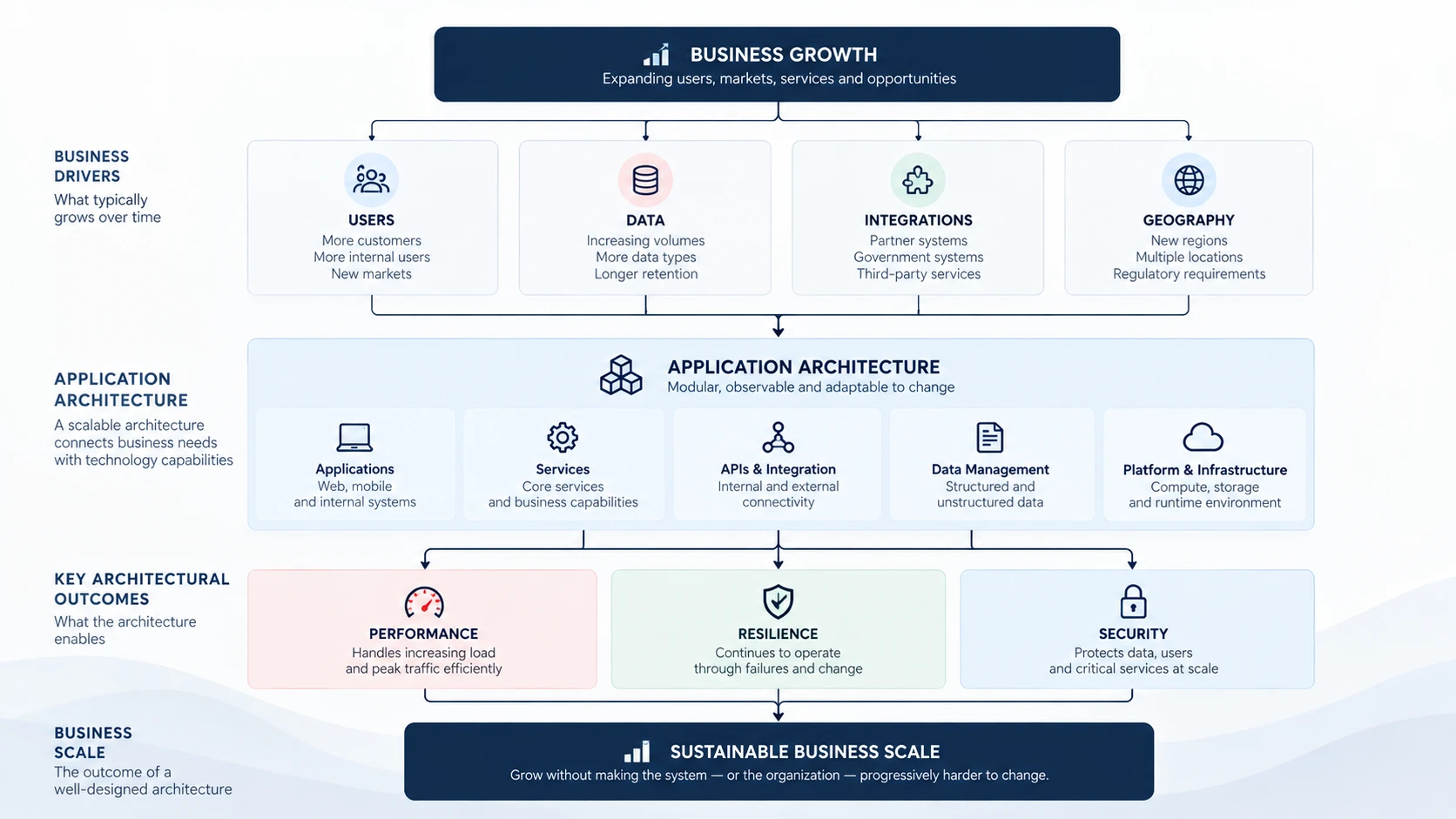
Before deciding how an application should scale, you need to understand what is actually expected to grow. Is it the number of users? The number of transactions? The amount of data? The number of integrations? The number of locations or markets the system operates in? Or perhaps all of them?
A system processing 100 transactions a minute has very different requirements from one expected to process 10,000. A B2B platform with a few hundred users may have completely different scaling characteristics from a consumer application with millions of users. This is why architecture decisions should begin with the expected business trajectory.
You need to understand things such as:
- expected user growth
- transaction volumes
- peak traffic patterns
- data growth
- integration volumes
- availability requirements
- geographic distribution
- critical business workflows
The important number isn't always today's workload.
It is the workload the business reasonably expects the platform to handle as it grows.
And that distinction matters. Designing for an imaginary future can introduce unnecessary complexity just as easily as designing only for today can create technical debt. The objective is to understand where the business is going and which parts of the architecture need room to move with it.
Keep the boundaries clear
As applications grow, dependencies tend to grow with them. A module that started out completely independent begins calling another module. That module starts depending on something else. Eventually, changing one part of the application means worrying about several other parts. This is one of the less obvious ways an architecture becomes difficult to scale.
Good architecture creates meaningful boundaries around business capabilities. That doesn't necessarily mean turning everything into a microservice. In many situations, a well-structured modular monolith can support significant growth without introducing the operational overhead of a distributed system.
The important question is:
Can different parts of the system evolve without unnecessarily affecting each other?
If they can, the architecture has room to grow. If they can't, adding more infrastructure may only postpone the underlying problem.
Don't confuse distribution with scalability
Microservices are often associated with scalable systems. But breaking an application into twenty services doesn't automatically make it scalable. It introduces networks, service dependencies, distributed tracing, deployment concerns, service ownership, failure modes and operational overhead. Those may be worthwhile when the system actually needs them. They may also be unnecessary if the application is still small and its boundaries aren't well understood.
The architectural decision should therefore start with the problem. What needs to scale independently? What needs to change independently? What needs to be isolated? Those answers may lead to microservices. They may lead to a modular monolith. They may lead to something in between.
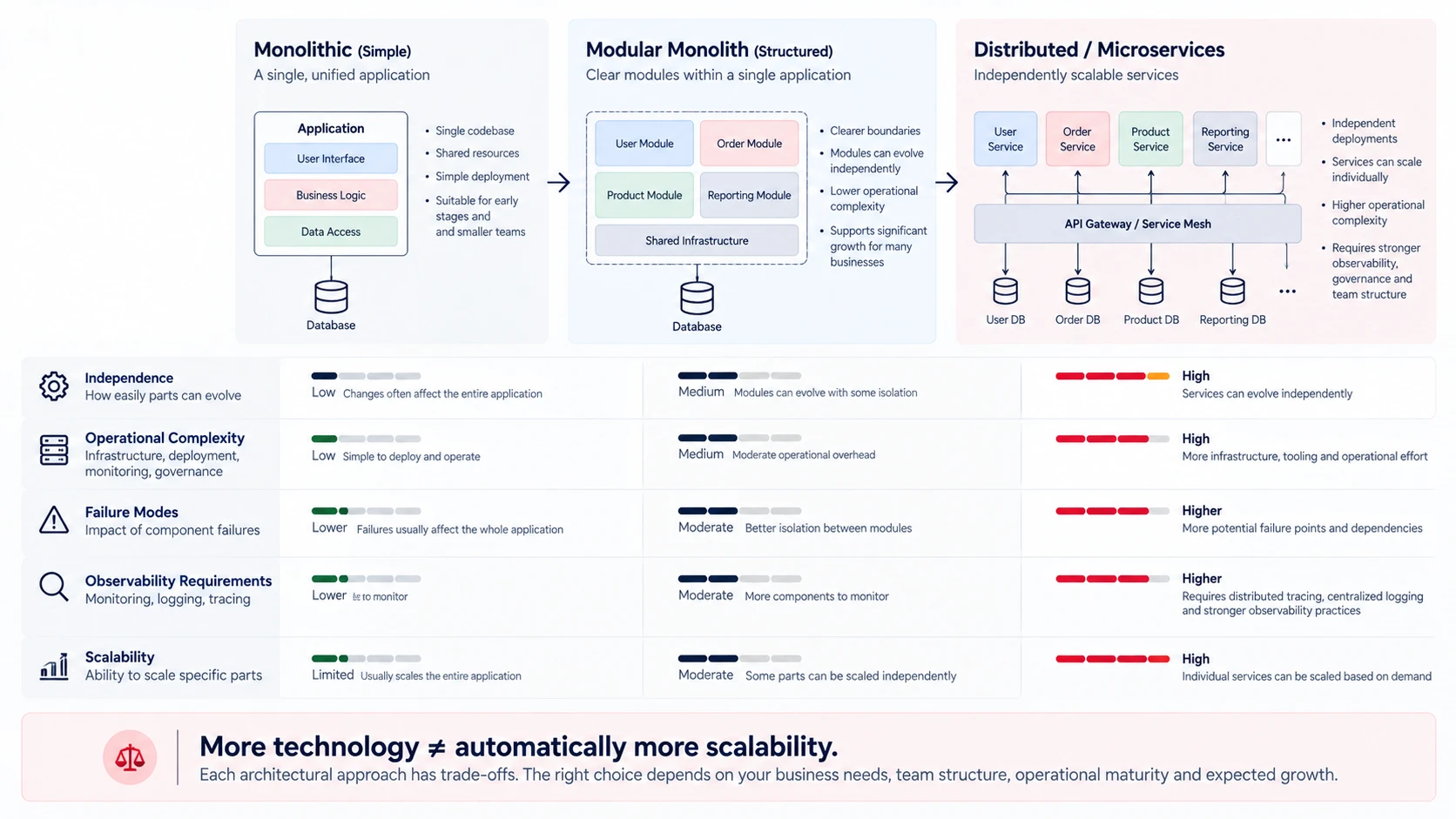
The technology pattern is a consequence of the architecture—not the definition of it.
Know where the bottlenecks are
Every system has limits. The problem isn't having limits. The problem is discovering them only after users start experiencing them. CPU can become a bottleneck. So can memory, database connections, storage I/O, network throughput, an external API, or even a badly designed query. And bottlenecks aren't always where you expect them to be. A system might have plenty of application capacity while the database is struggling. Or the database might be healthy while an external integration is slowing down the entire transaction.
This is where observability becomes part of the architecture. You should be able to look at a production system and understand what is happening—not simply know that something has gone wrong. Metrics can show where performance is deteriorating. Logs can provide detail around individual events. Distributed tracing can help connect a slow request across multiple services and dependencies.
Without that visibility, scaling becomes largely reactive. You add capacity, wait, see what happens, and repeat. A scalable architecture should make it possible to identify pressure points before they become major incidents.
Don't tie the application too closely to individual servers
There is a simple architectural idea behind much of horizontal scaling: if another application instance can be added without changing how the application works, scaling becomes much easier. This is why stateless application components are so useful. If sessions, temporary files, or other important state are tied to a particular server, adding another instance can introduce unnecessary complexity.
That doesn't mean an architecture must eliminate state. It means state should have a deliberate home. Sessions might belong in a distributed cache. Files might belong in object storage. Business data belongs in an appropriate persistent data store. The application layer can then scale without taking all of that state with it. It's a relatively simple decision, but it can make a significant difference later.
The database deserves its own scaling strategy
This is where many systems eventually hit a wall. Adding more application servers is relatively straightforward. Making a database handle ten times the workload isn't always. Poorly optimized queries, missing indexes, excessive joins, connection exhaustion, locking, large transactions and rapidly growing datasets can all become constraints.
And sometimes the solution isn't a more powerful database server. It might be query optimization. It might be caching. It might be read replicas, partitioning or archiving. In some systems, more advanced approaches such as sharding may eventually make sense.
But each of these decisions comes with trade-offs. Caching introduces invalidation and consistency concerns. Read replicas introduce replication considerations. Partitioning changes how data is accessed and maintained. Sharding can solve certain scaling problems while adding considerable operational complexity.
So the question isn't simply:
How do we scale the database?
It is:
What is actually limiting the database, and what is the simplest architectural change that addresses it?
Not every operation needs to happen immediately
Another common problem appears when every operation in a workflow is synchronous. A user performs an action, and the application waits for five other things to happen before responding. An order might trigger an email, an analytics event, document generation, a notification and synchronization with another system. Does the user really need to wait for all of those? Often, they don't.
Moving appropriate work into asynchronous processing can make a system more responsive and can also help isolate failures. Queues and event-driven processing can be useful here. But asynchronous architecture isn't free. It introduces its own concerns: retries, duplicate messages, ordering, failure handling and eventual consistency.
So the question shouldn't be:
Should we make this system event-driven?
It should be:
Which parts of this workflow genuinely benefit from being asynchronous?
That distinction matters.
If scaling requires repeatedly redesigning unrelated parts, the problem may be architecture rather than capacity.
Assume external systems will fail
Most modern applications depend on systems outside their own boundaries. Payment gateways. Identity providers. Government platforms. Communication services. Partner APIs. External data providers. Even if your own infrastructure is highly available, one of those dependencies can still become unavailable. A resilient architecture therefore needs to account for those failures. Timeouts, retries, circuit breakers, rate limiting and idempotency can all have a role. In some cases, queues can allow work to continue even when an external system is temporarily unavailable.
The goal isn't to pretend that failures won't happen. It's to make sure that one dependency failing doesn't automatically bring down everything that depends on it. And this is where architectural boundaries become particularly valuable. Good boundaries don't just make development easier.
They help contain failure.
Security needs to scale too
There is another dimension of scalability that doesn't always get enough attention. Security becomes harder as systems become larger. More services mean more endpoints. More integrations mean more trust relationships. More users mean more identities and permissions. Security therefore needs to be part of the architecture from the beginning. Identity and access management, least-privilege access, secrets management, encryption, network controls, audit logging and vulnerability management all become increasingly important as the platform grows.
But security also has to be practical. A control that is impossible for engineering teams to operate consistently isn't necessarily a useful control. The objective is to build security into the architecture and delivery process so that it continues to work as the system—and the organization—gets larger.
Your engineering process has to scale with the system
There is also a less obvious form of scalability:
the ability of the engineering team to keep changing the system safely.
Consider an application that can handle ten times its current traffic, but every production release still requires several manual steps and coordination across multiple teams. The infrastructure has scaled. The delivery process hasn't. Automated testing, CI/CD, infrastructure as code, environment consistency and reliable rollback mechanisms become increasingly valuable as systems and teams grow.
But there is another question worth asking:
Who owns each part of the system?
As platforms become larger, unclear ownership can become an architectural problem in its own right. A service that nobody clearly owns, a database that several teams modify independently, or a critical integration understood by only one person can all become constraints on future growth. Technical scalability and organizational scalability are therefore more closely connected than they first appear.
Design for the day something goes wrong
A system can perform beautifully under normal conditions and still have a fragile architecture. What happens when a database becomes unavailable? What happens when an external API stops responding? What happens when a deployment fails halfway through? What happens when a message is processed twice? What happens when one part of the infrastructure runs out of capacity?
These aren't unusual edge cases. Production systems eventually encounter them. High availability, backups, disaster recovery, health checks, graceful degradation and recovery mechanisms are therefore part of a scalable architecture.
The objective isn't to eliminate every possible failure. That's unrealistic. The objective is to understand how failure propagates through the system—and prevent one failure from becoming a much larger one.
Scaling without resilience can simply create a bigger system that can fail in a bigger way.
So, is your architecture ready?
There isn't a single technology that answers that question. You need to look at the system as a whole.
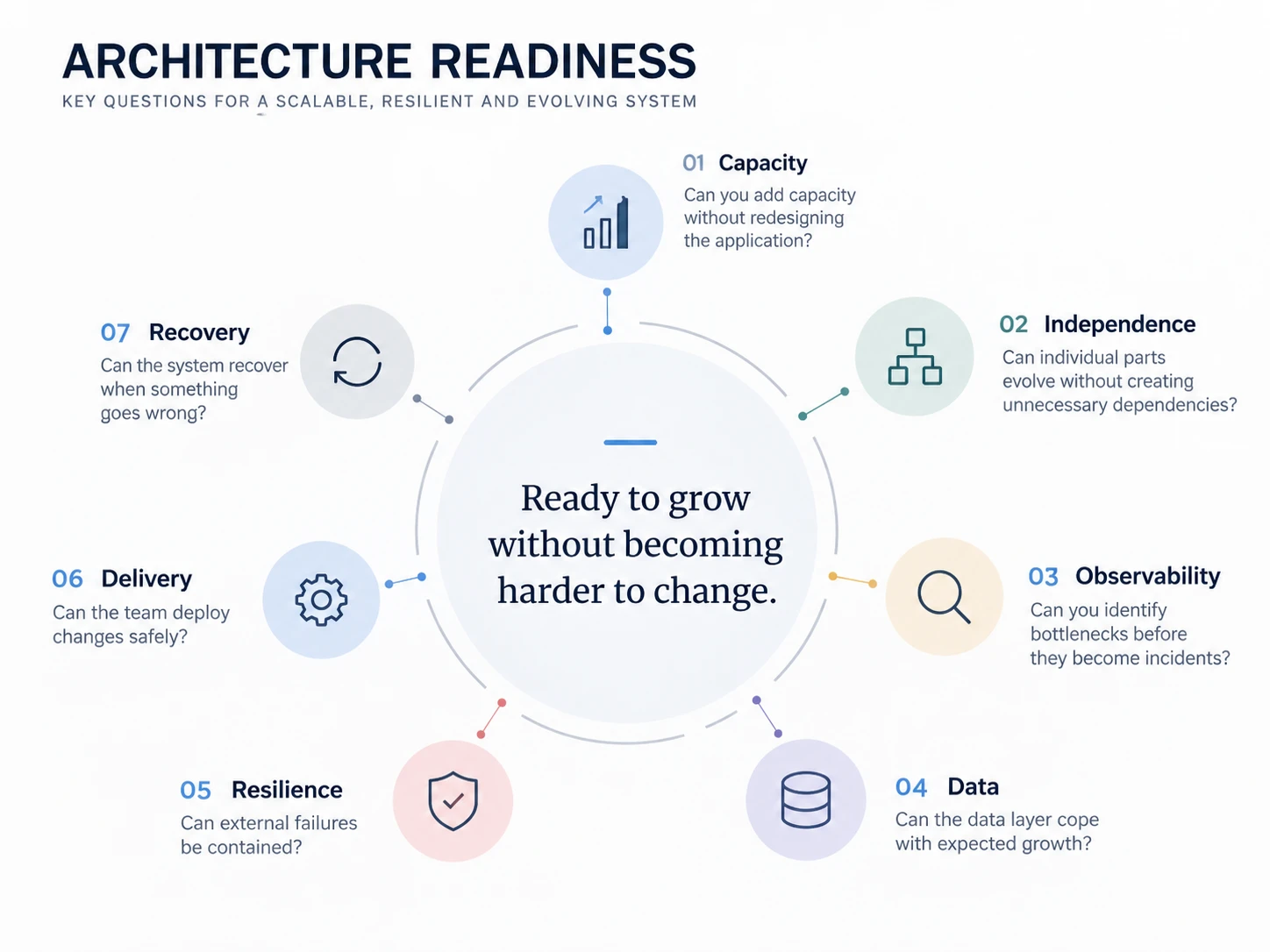
- ✓Can you add capacity without redesigning the application?
- ✓Can individual parts evolve without creating unnecessary dependencies?
- ✓Can you identify bottlenecks before they become incidents?
- ✓Can the data layer cope with expected growth?
- ✓Can external failures be contained?
- ✓Can the team deploy changes safely?
- ✓Can the system recover when something goes wrong?
And perhaps the most useful question of all:
If the business grows significantly over the next two years, which decisions we've made today are most likely to become constraints?
That question is worth asking while the system is still healthy. Not after it has already reached its limits.
Scale isn't about adding more technology
There is a tendency to associate scalable architecture with more sophisticated technology. Microservices. Kubernetes. Event-driven systems. Distributed databases. Multi-region infrastructure. Sometimes those are exactly what a system needs. Sometimes they aren't.
A well-designed monolith can scale surprisingly far. A badly designed distributed architecture can become difficult to operate long before it reaches its theoretical limits. The architecture should reflect the actual needs of the business, the workload, the team and the expected direction of growth.
Scale is not simply a measure of how much traffic a system can handle.
It is the ability to keep growing without making the system—and the organization around it—progressively harder to change.
That's what being ready for scale really means.